
GBP Optimization

Google Business Profile Optimization That Puts You in the Map Pack

For most home service businesses, the Google Business Profile brings in more calls than the website does — and it's usually the asset getting the least attention. We fix that.

Free profile audit. No contract, no obligation.

The case for the profile

Why Your Profile Matters More Than Your Website

Think about how someone actually finds you.

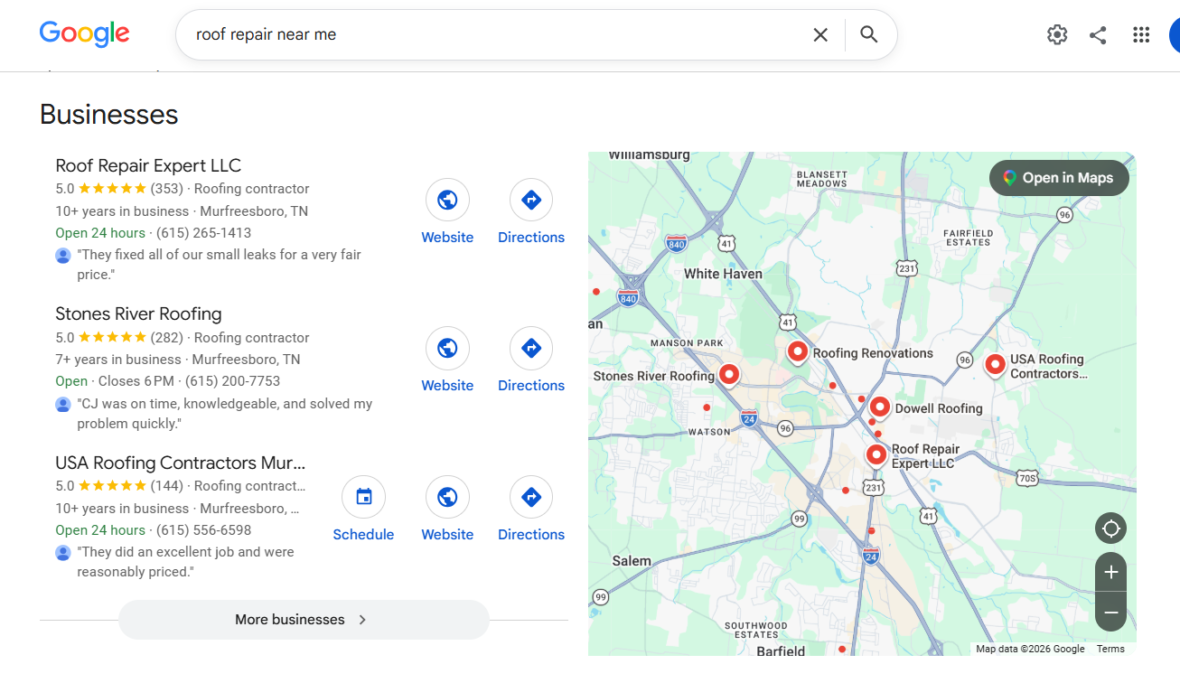
A homeowner’s water heater fails on a Saturday. They pull out their phone and search “water heater repair near me.” Before any website appears, Google shows a map with three businesses on it. Name, star rating, distance, hours, and a call button.

Most people tap one of those three. They never scroll. They never visit a website. They call.

That map is the Map Pack, and your Google Business Profile is the only thing that decides whether you’re in it. Your website supports it, but the profile is the asset doing the work.

This matters more in home services than almost any other industry, because:

  • Your customers search on a phone, often standing next to the problem

  • Many searches are urgent — they're calling whoever appears first, not researching for a week

  • They don't come to you. You go to them. That makes you what Google calls a service area business, and service area businesses have their own setup rules that most profiles get wrong

  • The call button is right there. A Map Pack listing can produce a booked job without the customer ever seeing your site

The eight we see most

Why Contractor Profiles Underperform

We’ve audited a lot of home service profiles. The same handful of problems come up over and over — and almost none of them are the owner’s fault. Google’s setup process doesn’t warn you about any of this.

  1. The primary category is wrong

    This is the most expensive mistake on this list. Your primary category tells Google what you are, and it outweighs almost everything else you can change. A drain cleaning company listed as “Plumber” competes with every plumber in the city instead of the handful doing drain work. A company doing mostly roof repairs listed as “Roofing contractor” instead of “Roof repair service” shows up for the wrong searches. Most profiles are set to whatever seemed closest during signup and never revisited.

  2. The service area is drawn far too wide

    It feels right to select every county you’d drive to. It hurts you. A service area covering half the state tells Google your relevance is spread thin across all of it, and you end up ranking strongly nowhere. Service area is not a wish list of where you’d take a job — it’s a signal about where you’re genuinely established.

  3. The address is set up wrong

    If customers don’t come to your location, your address should be hidden and your business configured as a service area business. Plenty of contractor profiles have a home address publicly displayed, or a storefront setting on a business with no storefront. Both cause problems, and one of them is a common cause of suspension.

  4. Someone else still owns the profile

    The marketing company you used in 2019 created the profile under their own account, and you’ve never had owner access. This is more common than most people expect. It means you can’t fully edit it, you can’t respond to a suspension, and if that company disappears, so does your ability to manage your own listing.

  5. No photos since verification day

    A profile with four photos from three years ago looks abandoned. Home services is one of the few industries where photos genuinely sell — before and after shots, crews on site, branded vehicles, finished work. Most contractor profiles have almost none.

  6. Reviews happen by accident

    Reviews arrive when a customer happens to feel motivated, which means good months and empty months. Google looks at how many you have, how recently they arrived, and what they say. A profile getting two reviews a month consistently beats one that got thirty in a burst two years ago.

If you recognized two or three of these, that’s normal. They’re all fixable, and most of them are fixable in the first month.

The work itself

What GBP Optimization Actually Involves

“Optimization” gets used loosely in this industry. Here’s specifically what we work on.

  • Categories

    We research which categories the businesses currently ranking in your area are using, then set your primary category to the one that matches the work you most want to be called for. Secondary categories get added for the services you also offer — without stretching so far that you dilute what you’re known for.

  • Service Areas & Address Settings

    We configure your profile correctly as a service area business, hide the address if customers don’t visit you, and set a service radius that reflects where you actually work and can realistically rank. Usually this means narrowing what’s already there.

  • Services, Products & Attributes

    Your services list is a ranking and conversion asset most profiles leave empty. We fill it out using the terms your customers actually search, with real descriptions rather than one-word entries. We also set the attributes that matter in trades — licensed, insured, emergency service, free estimates, veteran-owned, whatever applies to you.

  • Photos & Video

    We build a photo plan and a posting cadence: job-site work, before and after, your crew, your trucks, completed jobs by service type. Consistency matters more than volume. We’ll be straight with you about one thing here — geotagging photos is widely sold and there’s no reliable evidence it affects rankings. We don’t charge for it.

  • Reviews

    We set up a system for asking, so reviews arrive steadily instead of in bursts. That includes when to ask, how to make it easy, and how to respond. The language customers naturally use in reviews also affects which searches surface you, which is why how you ask matters as much as whether you ask.

  • Google Posts & Q&A

    We post regularly — offers, completed jobs, seasonal services — and seed the Q&A section with the questions your customers actually call and ask. Left alone, that section fills with questions from strangers and answers from nobody.

  • Website Connection & Tracking

    We tag your profile’s website link so you can see in your analytics exactly how much traffic and how many conversions came from the profile. We also set up call tracking in a way that doesn’t break the consistency of your business information across the web — done carelessly, call tracking can hurt local rankings.

  • Spam & Competitor Cleanup

    We identify fake listings, lead-generation listings, and out-of-area competitors ranking in your market, and we file the reports Google provides for exactly this situation. It doesn’t always work. When it does, a competitor disappears from the map and you move up. Most agencies skip this because it’s tedious.

The mechanics

How Google Decides Who Shows Up

Google uses three things to decide which businesses appear in the Map Pack. Understanding them is what separates realistic expectations from the promises you’ve probably been pitched.

  • Relevance

    How well your profile matches what the person searched. This is the part we have the most control over. Categories, services, description, reviews, and website all feed into it.

  • Distance

    How far you are from the person searching, or from the area they searched. This one is largely fixed. If someone searches from a neighborhood where a competitor is two miles away and you’re fifteen, that competitor has a real advantage for that search. Anyone claiming they can override proximity is either misunderstanding it or misleading you.

  • Prominence

    How well known and well established your business appears to be. Reviews, mentions across the web, consistent business information, links to your site, and general online presence all contribute.

What we’ll tell you that others won’t

Here’s the practical version: you won’t rank equally across your entire service area, and you shouldn’t expect to. What you can do is dominate the areas closest to you, then extend outward with location pages, content, and consistent local signals. That’s a real strategy. “We’ll get you #1 everywhere” is not.

Our Signature Method

How We Work

GBP optimization follows the same three-phase RankReady™ system we use on every campaign.

  1. 01

    Audit and fix

    We go through the profile line by line and document what’s wrong: categories, service area, address settings, missing services, ownership, suspension risks. Then we fix it. Most of the value in a GBP engagement lands in this phase, because most profiles have several foundational problems.

  2. 02

    Build

    Photo cadence, posting schedule, review system, Q&A, services buildout, and the website pages that support the profile. This is the ongoing work that moves you up over the following months.

  3. 03

    Monitor and defend

    We track your position across your service area, watch for suspensions and unauthorized edits, report spam competitors, and report back to you monthly in language you can actually use.

What this looks like on a calendar

What to expect: most profiles show measurable change within 30 to 90 days — more calls, more direction requests, better positions in the areas closest to you. Dense metros take longer. If your profile has foundational problems, the first month usually produces the biggest single jump.

We won’t promise you a Map Pack position in 30 days. Nobody can control that, and the agencies that promise it are counting on you not knowing.

Scope of work

What's Included

In the first month

8 items

  • Full profile audit with every issue documented
  • Category research and correction
  • Service area and address configuration
  • Complete services, products, and attributes buildout
  • Business description rewritten around what customers search
  • Photo audit and initial upload
  • Ownership verified and transferred to you if needed
  • Competitor and spam listing assessment

Ongoing each month

7 items

  • Google Posts on a set cadence
  • Photo uploads
  • Review generation support and response management
  • Q&A monitoring and seeding
  • Position tracking across your service area
  • Spam competitor reporting
  • A monthly report you can read in five minutes
<span>Always</span>

You own the profile. Owner access stays in your name, not ours. If we ever stop working together, everything we built stays with you and keeps working.

The Full List

Google Business Profile Optimization Checklist

If you’d rather do this yourself, here’s the actual list we work from. It’s not a teaser — everything we’d check is on it.

28-point checklist

Tick as you go

Setup and accuracy

8

Content

8

Engagement

4

Reviews

3

Technical

5

Answers

Common Questions

What is a Google Business Profile?

It’s the free listing Google gives every business, and it’s what powers your appearance in Google Maps and in the three-business map that shows up in local search results. It used to be called Google My Business, and a lot of people still call it GMB. Same thing.

What's the difference between Google My Business and Google Business Profile?

Nothing except the name. Google renamed it in 2021 and retired the old Google My Business app. If you see either term used, they mean the same product.

How do I optimize my Google Business Profile?

Start with the foundations: correct primary category, correct service area and address settings, complete services list, and an accurate business description. Then build consistently — photos every month, posts, and a steady flow of reviews. The checklist above covers everything we’d check.

Can I have a Google Business Profile without a public address?

Yes. If customers don’t come to your location, you set up as a service area business and hide the address. You still have to enter a real address for verification, but it won’t display publicly. This is the correct setup for most home service companies, and getting it wrong is a common cause of trouble later.

How long does GBP optimization take to work?

Most profiles show measurable change in 30 to 90 days. If yours has foundational problems — wrong category, misconfigured service area — the first fix often produces the biggest single jump. Competitive metros take longer, and building review count and prominence is a months-long effort rather than a switch.

How many reviews do I need to rank in the Map Pack?

There’s no threshold number. What matters is how you compare to the businesses currently ranking in your area, and how recently your reviews arrived. Two a month, every month, does more than a large count that stopped two years ago.

Why did my Google Business Profile get suspended?

Usually an edit to the business name, address, or category triggered a review. Keyword-stuffed business names, addresses that don’t match your verification, and virtual office addresses are common causes. Reinstatement is possible but depends on submitting the right documentation correctly the first time.

My competitor has a fake address and outranks me. Can anything be done?

Sometimes. Google provides a redressal complaint process for exactly this, and we file them on our clients’ behalf. It works often enough to be worth doing consistently, and it doesn’t work every time. We won’t pretend otherwise — but when a fake listing does come down, you move up.

Who owns the profile if we stop working together?

You do, always. We work as a manager on your profile, not the owner. Owner access stays in your name from day one. If we part ways, you keep the profile and everything we built on it.

Free GBP audit

Find Out What's Wrong With Your Profile

  • Your current Map Pack position for the searches that matter in your service area
  • Every setup error we find — categories, service area, address settings, missing information
  • Which competitors are outranking you and why
  • The first three things we'd fix

We call once, during business hours. No spam, no lists.

  • No obligation
  • You own your profile
  • No long contracts